You Won’t Believe These Foodie Photo Spots in Busan
Busan isn’t just Korea’s beach escape—it’s a feast for the eyes and stomach. I stumbled upon corners where steamed dumplings meet ocean views and neon-lit alleys glow with sizzling street food. Every bite tells a story, and every frame feels like a postcard. If you think Korean food stops at kimchi, trust me—you’re missing half the magic. This city blends flavor, culture, and visuals in ways I never expected. Let me take you through the spots where food, light, and scenery collide perfectly.
Why Busan? More Than Just Sea and Sand
Often overshadowed by Seoul’s global fame, Busan stands proudly as South Korea’s second-largest city and its coastal crown jewel. Nestled along the southeastern shore, it offers more than just beaches and sea breezes—it delivers a cultural rhythm shaped by tides, trade, and tradition. Unlike the polished pace of the capital, Busan pulses with authenticity. Its streets breathe with the energy of fishermen hauling in the morning’s catch, vendors calling out from market stalls, and families gathering around shared meals that stretch late into the night.
What sets Busan apart is how naturally food and daily life intertwine. Meals aren’t rushed—they’re moments of connection, often enjoyed in full view of the public eye. This openness creates endless opportunities for photography that feels alive, not staged. The city’s topography also plays a role: hills dotted with homes, harbors lined with boats, and markets bursting with color all serve as dynamic backdrops for culinary storytelling. Whether you’re watching an elderly woman flip pancakes over a sizzling griddle or capturing the steam rising from a bowl of hot mandu near the pier, the visuals are rich with meaning.
In recent years, Busan has drawn increasing attention from both domestic and international travelers seeking experiences beyond tourist traps. Its reputation as a food destination has grown, fueled by its proximity to the sea and deep-rooted culinary traditions. From humble street vendors to elegant seaside restaurants, the city offers layers of flavor waiting to be explored—and photographed. For the mindful traveler, especially women in their 30s to 50s who value meaningful, sensory-rich experiences, Busan offers a journey that nourishes both the soul and the camera roll.
Jagalchi Market: A Seafood Lover’s Visual Feast
No visit to Busan is complete without stepping into Jagalchi Market, the largest seafood market in Korea and a sensory explosion unlike any other. Located just steps from Nampo-dong Station, this bustling hub has been feeding the city for generations. As you enter, the salty tang of the sea mingles with the sharp scent of chili paste and garlic. Live octopuses twist in tanks, crabs scuttle across wet floors, and mounds of glistening squid, sea urchins, and mackerel are laid out like edible art.
For photographers, Jagalchi is a goldmine of candid moments and vibrant compositions. The morning light filtering through the market’s high windows casts soft glows on piles of red chili peppers beside silvery fish. Vendors in rubber boots and aprons shout prices, their faces etched with years of labor and pride. One of the most striking scenes is the octopus section, where fresh tentacles are still moving as they’re prepared—a powerful reminder of how close the food is to its source. Close-up shots of glistening fish eyes, textured squid skin, or a vendor’s hands cracking open a crab reveal the tactile beauty of this place.
But capturing these moments requires sensitivity. Always ask permission before photographing people, especially vendors who work long hours. A simple smile and a gesture toward your camera often suffice. The best time to visit is early morning, between 8:00 and 10:00 a.m., when the market is at its busiest and most photogenic. Avoid weekends if possible, as crowds can make navigation and clean shots difficult. For a full experience, head upstairs to the restaurant level, where you can select your own seafood and have it prepared on the spot. Watching a chef grill a whole fish or chop raw tuna into sashimi adds another layer to your visual story—one that connects the catch to the plate in real time.
Gukje Market & BIFF Square: Street Food Under Neon Lights
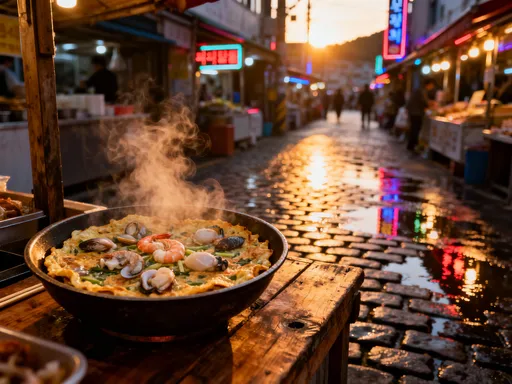
Just a short walk from Jagalchi, Gukje Market and the adjacent BIFF Square form the heart of Busan’s street food culture. Once a black market after the Korean War, Gukje has evolved into a lively network of covered alleys filled with everything from socks to souvenirs—but it’s the food stalls that truly shine. At night, the area transforms. Retro neon signs flicker to life, casting pink, blue, and gold reflections on rain-slicked pavement. The air fills with the sweet scent of caramelized sugar from hotteok stands and the spicy kick of tteokbokki sauce bubbling in metal pots.
BIFF Square, named after the Busan International Film Festival, pays homage to cinema with handprints of Korean stars embedded in the walkway. But after dark, it becomes a stage for food lovers. Long lines form at famous stalls like Tteokbokki Alley, where chewy rice cakes are drenched in fiery red sauce and topped with fish cakes and boiled eggs. The visual contrast is striking: bright red food against dark night skies, steam rising like smoke from a film set. For photographers, this is prime time. Use a tripod or stabilize your phone for long exposures that capture the blur of moving crowds and the sharp glow of neon signs. Even a simple shot of a paper cup filled with bubbling eomuk (fish cake soup) can look cinematic when framed by colorful umbrellas and glowing lanterns.
Don’t miss the hotteok vendors, especially in cooler months. These sweet pancakes, filled with brown sugar, nuts, and cinnamon, are pressed flat on griddles until golden and crispy. The process is mesmerizing to watch—and photograph. Capture the moment the vendor splits the pancake open, revealing the molten filling inside. Candid shots of people laughing, sharing skewers, or wiping sauce from their lips add warmth and humanity to your collection. The key is to blend in, move with the flow, and let the scene unfold naturally. This isn’t about perfect symmetry; it’s about capturing the joyful chaos of real life.
Gamcheon Culture Village: Art, Alleys, and Hidden Eats
Perched on a hillside overlooking the city and sea, Gamcheon Culture Village is one of Busan’s most visually stunning neighborhoods. Once a quiet residential area for refugees, it has been transformed into a living canvas of murals, sculptures, and painted houses stacked like colorful blocks. Winding staircases, hidden courtyards, and narrow alleyways create a maze-like charm that invites slow exploration. But beyond the art, this village holds a quieter secret: small, family-run eateries tucked into corners, serving food with heart and view.
As you climb the paths, you’ll stumble upon tiny cafes with names like “Cat Village Tea House” or “Sunset Noodles,” where owners greet visitors like old friends. Some serve sujebi, a hand-torn noodle soup simmered with potatoes and zucchini, perfect for chilly afternoons. Others offer sweet potato lattes or homemade bingsu, a shaved ice dessert topped with fruit and condensed milk. These aren’t flashy restaurants—they’re homes turned into hospitality, where the menu is short but the care is deep. Photographing food here feels intimate. A tray of bingsu on a wooden table, framed by a painted wall of blooming flowers and the sea in the distance, tells a story of warmth, creativity, and place.
For the best shots, visit in the late afternoon when the sun casts soft, golden light across the village. Look for angles that include both food and surroundings—perhaps a close-up of a spoon dipping into a bowl of soup, with a mural of a fish leaping in the background. The contrast between the rustic food and vibrant art creates a visual harmony that’s uniquely Busan. Be respectful of residents; many still live in these homes. Keep noise low, avoid blocking doorways, and ask before photographing private spaces. The beauty of Gamcheon lies not just in its colors, but in its community—and your photos should reflect that dignity.
Haeundae Beach & Dongbaekseom: Modern Eats with Ocean Views
If Gamcheon represents Busan’s artistic soul, Haeundae Beach embodies its modern elegance. As the city’s most famous beach, it draws crowds in summer, but the real magic happens year-round along its promenade, where sleek cafes, sky bars, and sashimi restaurants offer front-row seats to the sea. This is where traditional flavors meet contemporary design—glass walls, minimalist interiors, and open terraces that blur the line between indoors and ocean.
One standout is the row of seafood restaurants along Dongbaekseom Island, connected to Haeundae by a scenic walkway. Here, you can sit on elevated decks and watch waves crash below while enjoying fresh hoe (Korean-style raw fish) served on ice with radish strips, seaweed, and soy sauce. The presentation is clean, the flavors bright, and the view unforgettable. For photographers, this setting offers dramatic possibilities. Try shooting during golden hour, when the sun dips below the horizon and paints the sky in pinks and oranges. A plate of sashimi, backlit by the fading light, becomes a study in texture and color. Seagulls flying past a noodle bowl or couples toasting with soju under string lights add narrative depth.
Don’t overlook the cafes perched on stilts over the water. Some serve matcha lattes in clear glasses, allowing the green hue to contrast with the blue sea. Flat lay shots—overhead images of your drink, a notebook, and seashells on a wooden table—work beautifully here. The key is simplicity. Let the ocean be your backdrop, and avoid cluttered compositions. Even a single spoon resting on a saucer, with waves in the distance, can evoke a sense of calm and indulgence. Haeundae proves that fine dining and scenic beauty don’t have to be reserved for special occasions—they can be part of an everyday moment, perfectly framed.
Seomyeon: The Urban Pulse of Food & Fashion
As Busan’s commercial and transportation hub, Seomyeon pulses with energy day and night. Skyscrapers, shopping malls, and subway lines converge here, making it a favorite among locals for work, shopping, and—most importantly—eating. While it may lack the coastal charm of Haeundae or the artistry of Gamcheon, Seomyeon delivers something equally valuable: authenticity. This is where office workers unwind after long days, where friends meet for late-night snacks, and where food trends begin.
The alleys around Seomyeon Station come alive after sunset, lit by the glow of pojangmacha—temporary street tents covered in plastic sheeting and strung with bright signs. Inside, people sit on low stools, sipping soju and eating ramyeon (spicy instant noodles) topped with boiled eggs and dumplings. The steam rises, the conversation hums, and the city lights shimmer in the background. For photographers, these tents offer rich, moody scenes. Use a wide aperture to blur the busy street behind and focus on the hands holding a spoon, the condensation on a beer bottle, or the reflection of neon in a puddle.
Trendy bakeries and dessert cafes also thrive here, catering to a younger, fashion-conscious crowd. Try a slice of honey butter bread or a rose latte served in a delicate cup—ideal for flat lay photography on marble tables. The contrast between fast-paced urban life and the quiet pleasure of a warm pastry creates a compelling visual narrative. To capture movement, try a slightly slower shutter speed to blur passing pedestrians while keeping the food in focus. The goal isn’t perfection—it’s realism. Seomyeon reminds us that great food moments don’t require postcard views; sometimes, they happen on a crowded sidewalk, shared with strangers and lit by fluorescent lights.
How to Eat & Shoot Like a Local: Practical Tips
Capturing beautiful food photos in Busan doesn’t require expensive gear—just intention and respect. Start with lighting. Natural light is your best friend, especially in the morning or during golden hour. Avoid using flash in markets or small eateries; it can disturb others and wash out colors. Position yourself near windows or open fronts to let the light enhance your shot.
Always ask before photographing people. A simple nod or hand gesture toward your phone is often enough. In markets, vendors may expect a small purchase in exchange for a photo—buying a skewer or a cup of tea builds goodwill. Be mindful of space; many stalls are small, and blocking foot traffic is frowned upon. Use a compact phone or small camera to stay unobtrusive.
Timing matters. Visit popular spots early to avoid crowds. Jagalchi is best at 8 a.m., Gamcheon by 3 p.m., and BIFF Square after 7 p.m. for night shots. Carry wipes or hand sanitizer—street food is delicious but messy, and clean hands make handling your device easier.
Finally, shoot with purpose. The most powerful images aren’t just pretty—they tell a story. Capture the hands that prepare the food, the steam rising from a bowl, the laughter around a shared table. Let your photos reflect the warmth, effort, and culture behind each meal. When you return home, your gallery won’t just show what you ate—it will remind you of how Busan made you feel.
Conclusion: Where Flavor Meets Frame
Busan is more than a destination—it’s an experience that engages every sense. From the salty air of Jagalchi Market to the quiet beauty of Gamcheon’s hillside cafes, this city turns every meal into a moment worth savoring and preserving. Its food is not just sustenance; it’s a reflection of history, community, and place. And when you pair that with the city’s natural and urban beauty, you get a visual feast that goes far beyond the plate.
For women who travel to connect, to recharge, and to capture life’s quieter joys, Busan offers something rare: authenticity without pretense. You don’t need a perfect Instagram grid to appreciate it. You just need to slow down, order another round of hotteok, and let the city unfold around you. The best photos aren’t the ones with the most likes—they’re the ones that, years later, still make you smile because they capture a real moment, a true taste, a place you were truly present.
So pack your camera, your curiosity, and your appetite. Let Busan surprise you with its flavors, its light, and its heart. Because in this coastal gem, every bite has a story, and every story deserves to be seen.