Lost in the Stone Canyons: A Private Journey Through Petra’s Hidden Districts
Petra, Jordan, is more than just a wonder—it’s a living maze of sandstone and secrets. Most visitors follow the same path to the Treasury and call it a day, but I ventured deeper into its lesser-known districts, where ancient homes, forgotten tombs, and quiet plazas whispered stories of a once-thriving city. This is not just a tourist trail; it’s an intimate encounter with history, one winding alley at a time. Beyond the postcard-perfect façade lies a layered urban landscape, where every cliff and courtyard tells of daily life, spiritual devotion, and social hierarchy. To walk beyond the Siq is to step into the rhythm of a city that once pulsed with movement, trade, and ritual.
Beyond the Postcard View
Petra is a UNESCO World Heritage Site and one of the most iconic archaeological destinations on Earth. Carved into the rose-red cliffs of southern Jordan, it has long captured the imagination of travelers, historians, and dreamers alike. Yet for all its fame, Petra remains profoundly misunderstood. Many see it as a ceremonial stage—a place of grand tombs and ceremonial facades—but it was, in truth, a bustling city of thousands, complete with homes, markets, temples, and public spaces. The narrow canyon of the Siq leads to the dazzling Treasury, the image reproduced on countless postcards, but that is only the threshold. Beyond it unfolds a complex urban fabric, divided into districts that reveal the full scope of Nabataean civilization.
My journey began not with awe at the Treasury, though that moment was unforgettable, but with curiosity about what lay beyond. Why do so few continue past the main monuments? What did ordinary life look like in this city carved from stone? These questions led me to explore Petra’s residential quarters, administrative zones, and spiritual high places—areas rarely included in standard tours. This deeper exploration transformed my understanding of Petra from a static monument into a living, breathing cityscape. The distinction matters. Recognizing Petra as a true urban center allows us to appreciate not just its beauty, but its ingenuity, resilience, and humanity.
The Nabataeans were master planners and engineers, adapting their city to the harsh desert environment with remarkable sophistication. Water management systems channeled seasonal rains into cisterns and channels, supporting agriculture and daily use. Streets followed natural contours, connecting neighborhoods with purpose and efficiency. Unlike many ancient cities built on grids, Petra grew organically, shaped by topography and necessity. This organic growth is evident in the way districts cluster around water sources, high vantage points, and trade routes. To walk through these areas is to trace the logic of a people who thrived in isolation yet engaged deeply with the wider world.
The Siq to the Treasury: First Impressions and the Crowd Problem
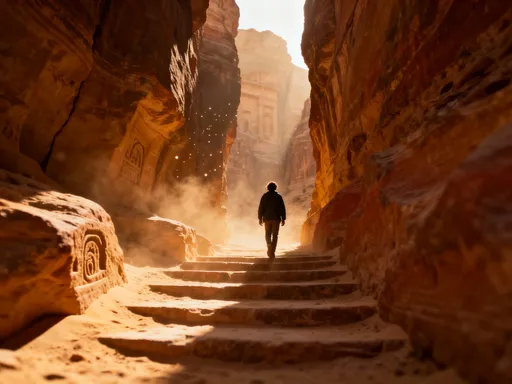
The journey into Petra begins with the Siq, a narrow, winding gorge flanked by towering cliffs that rise over 80 meters on either side. Sunlight filters in unevenly, casting shifting patterns on the sandstone walls. The air is cool, the silence broken only by footsteps and the occasional whisper. After about a kilometer, the path turns, and suddenly, the Treasury—Al-Khazneh—appears framed perfectly between the rocks. It is a breathtaking sight, its Hellenistic façade intricately carved with columns, statues, and urns. For first-time visitors, the emotional impact is profound, a moment suspended in time.
Yet this awe is often undercut by the sheer volume of people. On peak days, hundreds pass through the Siq every hour, their voices echoing off the stone. The space, designed for intimacy, becomes crowded and noisy. Visitors take photographs, linger briefly, and then move on. There is little room for quiet reflection. The Treasury, originally a royal tomb, is treated more like a photo opportunity than a sacred space. This commodification of experience is one of the challenges of mass tourism at Petra. The site’s popularity, while a testament to its significance, also threatens the depth of engagement it deserves.
Recognizing this, I made a deliberate choice: to pause, breathe, and then keep walking. The true city of Petra begins just beyond the Treasury. While most tourists turn back or head straight to the Monastery—a distant but famous site—I followed lesser paths branching to the west and north. These routes lead into residential zones, administrative buildings, and public plazas, areas that reveal the city’s functional heart. The shift in atmosphere is immediate. The crowds thin, the noise fades, and the sense of discovery returns. This is where Petra stops being a monument and starts being a place where people lived, worked, and gathered.
Walking away from the main trail, I noticed subtle changes in the rock—tool marks from ancient chisels, worn steps smoothed by centuries of feet, small niches that once held oil lamps. These details are easy to miss in the rush to the next highlight. But they speak volumes about daily life. The transition from ceremonial center to urban district is not marked by a sign, but by a shift in scale and purpose. The grand tombs give way to modest homes, the open plaza to narrow alleys. This is not a decline in importance, but a shift in focus—from spectacle to sustenance, from memory to life.
The Residential Heart: Houses and Daily Life in Ancient Petra
West of the main temple and Treasury complex lies one of Petra’s most revealing but least-visited areas: the residential district. Here, hundreds of homes were carved directly into the rock face or constructed from stone blocks. Unlike the ornate tombs, these dwellings are simple, functional, and deeply human. Many feature multiple levels connected by internal staircases, with upper floors likely used for sleeping and lower levels for cooking and storage. Courtyards, though small, provided light and ventilation, and some include remnants of water channels, evidence of the Nabataeans’ advanced hydraulic engineering.
Archaeological surveys have uncovered household items such as grinding stones for grain, storage jars, cooking pots, and even children’s toys. These artifacts suggest a society where family life was central. Homes were often clustered in small compounds, possibly extended family units, indicating a close-knit community structure. The presence of multiple entrances and shared walls suggests a dense urban layout, not unlike modern Middle Eastern neighborhoods. This domestic architecture reveals a city designed not just for the elite, but for everyday people—merchants, artisans, farmers, and laborers who kept Petra functioning.
What stands out is the adaptability of the Nabataeans. They did not flatten the landscape to fit their needs; they worked with it. Homes follow the natural contours of the cliffs, stepping up slopes and wrapping around boulders. This integration with the environment minimized construction effort and maximized protection from sun and wind. The use of local sandstone meant buildings blended seamlessly into the surroundings, a form of ancient sustainable design. Even today, the thermal mass of the stone helps regulate indoor temperatures, keeping homes cool in summer and warm in winter.
These residential areas also reflect social stratification. While most homes are modest, a few larger, more elaborate dwellings suggest the presence of wealthier families or officials. Some include decorative elements like pilasters or cornices, though never on the scale of the royal tombs. This gradient—from simple to refined—mirrors the social fabric of a city with distinct classes but shared cultural values. The absence of grand palaces or fortifications indicates a society where power was expressed more through religious and funerary monuments than through residential display.
The Theater and Surrounding Quarters: Where Culture and Community Met
Nestled between the residential zone and the main ceremonial area is Petra’s theater, a 7,000-seat auditorium carved into the hillside. Built during the first century CE, it reflects Roman influence but retains distinct Nabataean characteristics in its layout and acoustics. Unlike purely Roman theaters, which were freestanding structures, Petra’s was integrated into the natural slope, reducing construction effort while enhancing sound projection. Its location, facing the city rather than a scenic backdrop, suggests it was designed for civic engagement, not just entertainment.
The theater was more than a venue for performances; it was a space for public assembly, legal proceedings, and religious ceremonies. Its proximity to administrative buildings and market areas underscores its role as a hub of urban life. Archaeological evidence shows that the surrounding quarter once hosted shops, workshops, and civic offices. Stone counters with niches for goods, storage rooms, and inscriptions in Nabataean script point to a bustling commercial district. This area would have been alive with the sounds of bargaining, hammering, and conversation—far removed from the silence of the tombs.
The integration of culture, commerce, and governance in this zone reveals Petra’s evolution as a cosmopolitan city. While the Nabataeans were originally a nomadic people, their control of incense trade routes brought wealth and exposure to foreign ideas. Greek, Roman, and Egyptian artistic styles appear in Petra’s architecture, not as imitations, but as adaptations. The theater, for instance, combines Roman seating arrangements with local craftsmanship. Similarly, market stalls display goods from as far as India and Arabia, indicating a city connected to long-distance trade networks.
What makes this district particularly meaningful for modern visitors is its sense of accessibility. Unlike the towering tombs, which inspire awe but distance, the theater and market areas feel relatable. One can imagine families attending performances, merchants weighing spices, or scribes recording transactions. These are universal experiences, bridging centuries. Walking through this quarter, I found myself not just observing history, but feeling its echoes in the rhythm of urban life—a reminder that Petra was not a city of the dead, but of the living.
The Royal Tombs District: Power, Prestige, and Personal Legacy
Along the eastern cliffs of Petra, a series of monumental tombs rise dramatically against the sky. Known collectively as the Royal Tombs, they include the Urn Tomb, the Corinthian Tomb, the Palace Tomb, and the Silk Tomb, each distinguished by its architectural style and scale. These are not mere burial sites; they are statements of power, identity, and eternal memory. Carved at great expense and effort, they were likely reserved for Nabataean royalty and high-ranking officials, their facades designed to impress and endure.
The Urn Tomb, one of the largest, features a wide terrace and a central chamber that was later converted into a Byzantine church, evidence of Petra’s continued significance long after the Nabataean period. The Corinthian Tomb, with its elaborate columns and pediment, reflects Hellenistic influence, while the Palace Tomb mimics multi-story buildings, suggesting a desire to replicate earthly grandeur in the afterlife. The Silk Tomb, named for the swirling patterns in its sandstone, appears almost alive in the changing light, its colors shifting from pink to gold to deep red.
What makes this district feel more personal than ceremonial is the intimacy of scale and the sense of individual legacy. Unlike the Treasury, which may have had a ritual or symbolic function, these tombs were built for specific people. Inscriptions, though often eroded, once named the deceased and their lineage. The choice of location—high on the cliff, visible from the city—ensured that the dead remained part of the community, watching over the living. Burial practices in Petra were not about separation, but continuity.
Walking among these tombs at sunset, when the crowds have left and the light softens, is a profoundly moving experience. The silence is deep, broken only by the wind. The facades, once symbols of status, now evoke reflection on mortality, memory, and what we leave behind. For the Nabataeans, the afterlife was not an abstract concept, but a continuation of identity. These tombs were not endpoints, but eternal homes. In that light, they feel less like monuments and more like invitations—to remember, to honor, to contemplate.
High Places and Hidden Paths: Spiritual Spaces Beyond the Center
One of Petra’s most powerful experiences lies beyond the main circuit: the High Place of Sacrifice. Reached by a steep 800-step climb, this altar sits atop a mountain with panoramic views of the entire city. Unlike the carved monuments below, this site was built from stone blocks, arranged in concentric platforms with offering tables and basins for libations. It was a place of ritual, where priests conducted ceremonies visible to the city below—a physical and symbolic connection between the divine and the urban.
The journey to the High Place is as meaningful as the destination. The path winds through narrow gullies and open ridges, offering changing perspectives on Petra’s layout. From above, the city’s organization becomes clear—the clustering of homes, the alignment of major axes, the strategic placement of water channels. This vantage point reveals Petra not as a collection of isolated monuments, but as a unified, intentional design. Other high places, such as the High Place of the Incense Altar, serve similar functions, forming a network of spiritual nodes integrated into the landscape.
Religion in Petra was not confined to temples; it permeated daily movement. Small altars appear along pathways, at crossroads, and near water sources, suggesting that worship was woven into routine activities. Pilgrims and residents alike would have made offerings as they traveled, turning the entire city into a sacred geography. This integration reflects a worldview in which the spiritual and the practical were inseparable. There was no strict division between secular and sacred space—every journey could be an act of devotion.
For the modern traveler, these high places offer solitude and perspective. Away from the main trails, the sense of discovery returns. The physical effort of the climb mirrors the emotional journey of reflection. Standing at the altar, looking down on the city carved into stone, one feels both small and connected—to history, to nature, to something greater. These spaces remind us that Petra was not just a city of trade and tombs, but of belief and meaning.
Practical Insights: Navigating Petra’s Districts Like a Local Explorer
To truly experience Petra’s depth, planning is essential. The site covers over 260 square kilometers, and while the main path to the Treasury and Monastery is well-trodden, the lesser-known districts require more thoughtful navigation. The best time to explore is early morning, shortly after the gates open at 6:00 a.m. During these hours, the light is soft, the temperature mild, and the crowds minimal. Another option is to visit during the off-season—late autumn or early spring—when tourist numbers drop significantly.
A recommended route begins with the Siq and Treasury, not to skip tradition, but to acknowledge it before moving on. From there, head west toward the residential district, then north to the theater and market area. After a break, continue to the Royal Tombs, allowing time for quiet observation. In the afternoon, tackle the High Place of Sacrifice while the light is still strong. This loop covers multiple districts without excessive backtracking and can be completed in a full day with moderate pacing.
Proper preparation enhances both comfort and safety. Sturdy, closed-toe hiking shoes are essential—the terrain is uneven and often rocky. A wide-brimmed hat, sunscreen, and at least two liters of water per person help combat the desert heat. While digital maps and GPS apps are useful, a physical map from the visitor center provides reliable orientation, especially in areas with poor signal. Carrying a small notebook to sketch or journal adds a personal dimension to the experience.
Perhaps the most valuable choice is to hire a local guide. Knowledgeable guides not only provide historical context but also share stories passed down through generations. They know hidden paths, seasonal changes, and cultural nuances that enrich the journey. Supporting local guides also promotes responsible tourism, ensuring that the benefits of visitation reach the communities closest to Petra. Their presence transforms a sightseeing trip into a meaningful exchange.
Conclusion: Rediscovering Petra as a Living City
Exploring Petra’s hidden districts reshaped my understanding of this ancient city. It is not merely a collection of rock-cut wonders, but a complex urban organism that once thrived on innovation, community, and spiritual depth. The Treasury is unforgettable, but it is only the beginning. The residential homes, the theater, the royal tombs, and the high places each add a layer to the story—one of daily life, cultural exchange, personal legacy, and sacred connection.
Slow, mindful travel allows us to move beyond iconic landmarks and engage with the full humanity of a place. In Petra, this means walking the quiet alleys, sitting in empty plazas, and imagining the lives that once filled them. It means recognizing that a city carved in stone was also built in memory, tradition, and resilience. The Nabataeans are gone, but their presence lingers in every chiseled step, every water channel, every shadowed doorway.
For travelers, especially those seeking depth and authenticity, Petra offers a rare opportunity: to walk not just through ruins, but through time. By venturing beyond the well-worn path, we honor the city in a more complete way—not as a monument frozen in the past, but as a living legacy shaped by people who lived, loved, and believed in something lasting. The next time you visit Petra, let curiosity guide you past the Treasury. Let the stone canyons lead you deeper. You may find, as I did, that the true wonder of Petra is not in its grandeur, but in its humanity.